
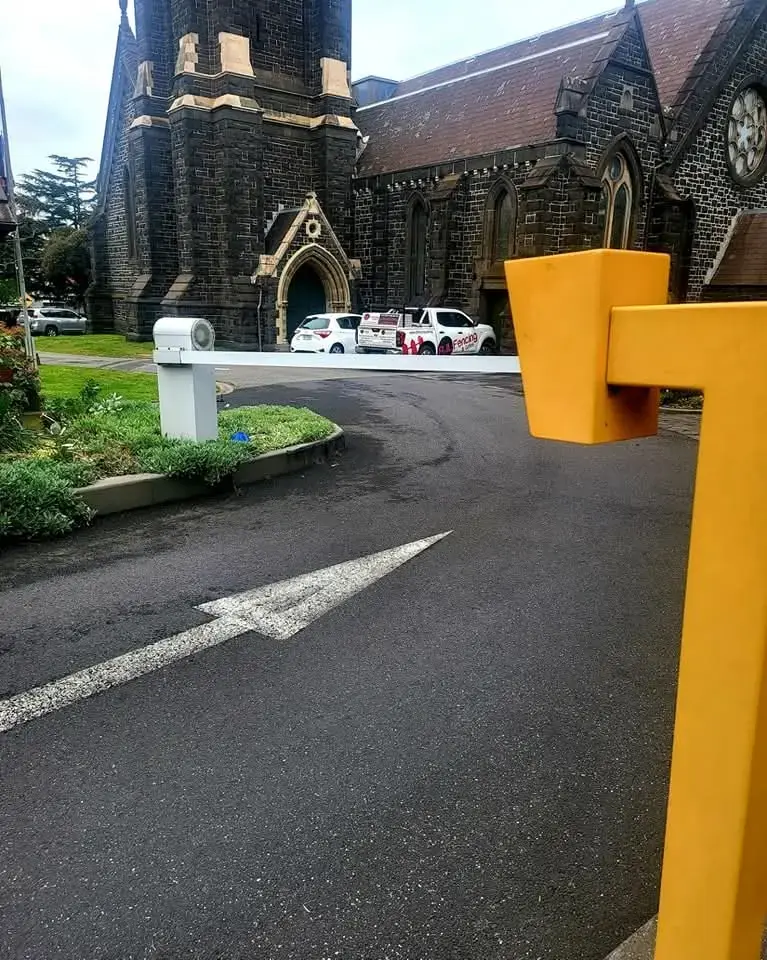
Start with the school’s access plan
Record how students, staff, visitors, contractors and delivery vehicles use each entrance. Identify teaching periods, arrival and departure peaks, accessible routes and emergency access. Victorian government-school projects must also follow the applicable Department of Education and Victorian School Building Authority requirements; the Building Quality Standards Handbook addresses fencing, gate access and electronic security coordination. A school driveway should not rely on a vehicle lane as the routine pedestrian route.
Confirm the standards and editions for the scope
The project team must identify applicable legislation, client specifications, engineering requirements and standards for the selected equipment. AS/NZS 60335.2.103 addresses the safety of electric drives for gates, doors and windows within its scope; it does not, by itself, establish compliance of an entire school site. The 2024 edition has a published transition from the 2016 edition, so the equipment and project documentation must establish the applicable edition. Fencing, accessibility, electrical work and emergency-egress requirements also depend on the installed system and site.
Assess mechanical and movement hazards
Review crushing, shearing, drawing-in and impact hazards throughout the travel path, including opening and closing. Inspect supports, guides, rollers, hinges, end stops and the area into which the gate retracts or swings. WorkSafe guidance identifies the risk of large sliding gates falling when retention or travel controls fail. The design must address foreseeable manual use and equipment faults as well as automatic operation. Mesh infill can limit reach-through in a suitable design, but a description such as “358 anti-climb mesh” does not prove that every finger, shear or trapping hazard has been controlled.
Separate vehicle presence from pedestrian protection
An inductive loop, radar sensor or virtual loop provides information about vehicles. OPTEX describes the OVS-02GT as an above-ground vehicle detector mounted about 500 mm above the driving surface; it ignores pedestrians. It must not be described as an overhead child detector or as a universal fail-safe safeguard for school gates. Select protective devices and monitored interfaces according to the gate or barrier application, manufacturer instructions and risk assessment. Safety edges, suitable protective sensing, guarding, separation and force-control functions may form part of that design. No single sensor removes the need to assess the whole entrance.
Scope credentials, intercoms, ANPR and portal functions
RJL checks existing wiring, controller interfaces and access workflows before proposing integration. Cards, fobs, keypads, intercoms and ANPR can provide different authorisation options where the equipment supports them. MagicKeys is RJL’s fully customisable portal, developed in-house over two years. RJL can custom-build supported entry and management functions around the school’s infrastructure; the proposal must define permissions, scheduling, reporting and any third-party connections. Camera placement, access to footage and data retention must follow the school’s applicable privacy and CCTV requirements. For government schools, check Department requirements before combining electronic systems.
Stage installation around a working campus
Agree heavy and disruptive works outside teaching and peak arrival and departure windows wherever the planned scope requires it. Document temporary fencing, exclusion zones, vehicle movements, alternative pedestrian routes and any necessary closures. Coordinate school inductions, civil and electrical works and the programme with the site representative. The method must keep construction activity and stored materials separated from students and other campus users.
Commission, document and hand over
The agreed commissioning scope should test normal operation, protective devices, obstruction response and force limits where applicable, as well as the relevant fault and power-loss behaviour. Confirm structural retention and manual-operation arrangements with competent personnel. Staff must receive instructions for emergency controls, reporting faults and the site’s agreed response procedure. Do not instruct untrained users to force, disengage or move a damaged gate. The handover should identify the installed equipment, completed tests, settings, operating instructions and outstanding actions.
Maintain the safety design throughout the lifecycle
Set service intervals from cycle demand, environment, manufacturer instructions, condition and the consequence of a fault. Keep inspection and repair records, and reassess the design when hardware, traffic or access arrangements change. Faulty gates require competent assessment and appropriate make-safe controls before use resumes. RJL offers a free initial on-site maintenance report and structures subsequent lifecycle servicing around the site; the maintenance agreement defines visits, records and response expectations. Warranty coverage is assessed against the written terms and applicable law.
Review real school project evidence
RJL’s Toorak College case study describes a boom-gate and access-control upgrade in Mount Eliza, including vehicle detection, commissioning and staff handover. It is useful procurement evidence for that delivered scope. It does not prove that a different school’s sliding gate meets every requirement. Book a site assessment to establish the controls, programme and records your own campus needs.